Holy Controllers: Inside the American Obsession With Building Sacred Spaces for Japanese Games
When Marcus Webb got his hands on a first-press copy of Shadow of the Colossus for PS2 back in 2005, he didn't just slide it onto a shelf. He wrapped it in a cloth sleeve, set it on the highest point of his bookcase, and—his words—"kind of just stood there for a minute." He was sixteen. He didn't have a word for what he was doing. Two decades later, the word is shrine.
Across the US, a quietly growing community of Japanese gaming enthusiasts has started treating their collections less like hobby accumulations and more like devotional objects. We're talking dedicated rooms, custom lighting rigs, incense, hand-lettered labels, and organizational philosophies borrowed directly from Japanese aesthetic traditions. The midnight launch isn't just about being first anymore. It's about bringing something sacred home.
What Even Is a Game Shrine?
The term gets thrown around loosely online, but in practice, a game shrine tends to share a few recognizable features. There's intentionality—nothing is placed randomly. There's reverence for the object itself, meaning sealed copies are often displayed as sealed copies rather than opened. And there's almost always a visual language borrowed from Japanese domestic spaces: clean lines, negative space, meaningful groupings.
The Japanese concept of ma—the thoughtful use of empty space—shows up constantly in how these collectors arrange their pieces. A single Famicom cartridge on a small wooden stand, surrounded by breathing room, communicates something entirely different from a wall of crammed shelves. It says: this matters.
Nintendo hardware and FromSoftware collector's editions seem to dominate the shrine aesthetic right now, though collectors from the Sega Saturn and PC-Engine communities have been doing versions of this for years. What's changed is the vocabulary and the visibility. TikTok and YouTube have given shrine builders an audience, and that audience has grown fast.
The Psychology of the Altar
Dr. Priya Nambiar, a consumer psychologist based in Austin who studies identity and object attachment, isn't surprised by the trend. "When people invest deeply in a cultural product—especially one that carries the weight of a foreign tradition—the physical object becomes a stand-in for the whole experience," she explains. "The shrine is basically a materialized form of respect. It's saying, 'I take this seriously enough to give it a home.'"
There's also something about Japanese gaming culture specifically that lends itself to this kind of treatment. Japanese game publishers have long understood the power of the physical artifact. Collector's editions from companies like Atlus, Capcom, and Square Enix routinely include art books, cloth maps, and resin figures that feel designed to be displayed, not just owned. The packaging itself often references Japanese craft traditions—minimal design, high-quality materials, deliberate color palettes. American fans aren't just collecting games; they're collecting objects that were already asking to be treated with care.
From Collector to Curator
Take Danielle Osei, a 28-year-old graphic designer from Portland who started her dedicated game room three years ago after a trip to Kyoto where she visited several actual Shinto shrines. "I came back and looked at my shelves and thought, these don't honor anything," she says. "They're just storage."
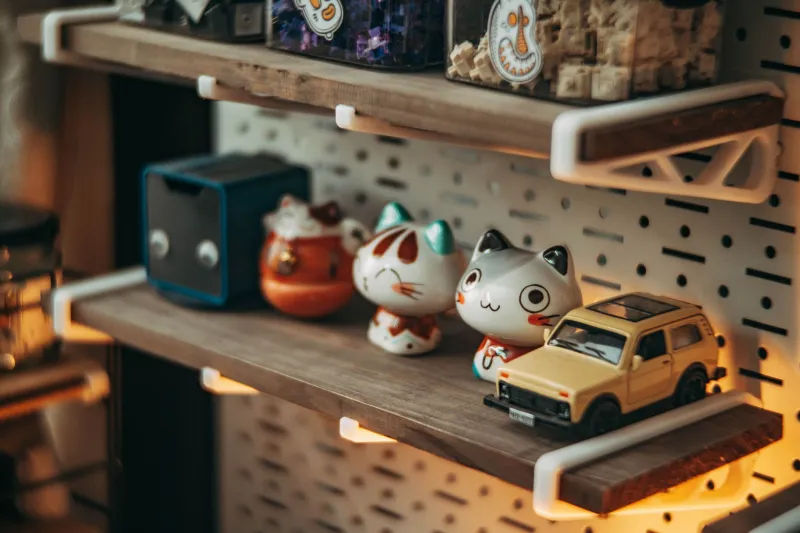
She spent the next several months rebuilding her setup from scratch. She sourced wooden display risers from a Japanese import shop in Seattle, invested in warm LED strip lighting that mimics candlelight, and started grouping her collection thematically rather than alphabetically. Her centerpiece is a complete set of original Mother series releases—Japanese market copies, all sealed—displayed on a small elevated platform she built herself from hinoki wood, the same aromatic cypress used in traditional Japanese architecture.
"People come over and they stop," she says. "They don't know exactly what they're looking at, but they feel something. That's the whole point."
Marcus, now 36 and living in Columbus, Ohio, has taken a slightly different approach. His shrine focuses exclusively on FromSoftware—every collector's edition from Dark Souls through Elden Ring, plus Japanese import pressings of the studio's earlier, more obscure titles. He keeps a small notebook nearby where guests can leave comments, a direct nod to the visitor books kept at Japanese temples.
"It sounds pretentious when I describe it," he admits, laughing. "But when you're standing in front of it, it just feels right. These games changed my life. They deserve better than a bin."
The Marketplace Feeding the Movement
The shrine-building trend hasn't gone unnoticed by the market. Specialty retailers like Nin-Nin Game and Play-Asia have seen consistent growth in demand for Japanese market collector's editions among US buyers. On Etsy, searches for "game display stand" and "collector's edition display" have spiked noticeably over the past two years, with several sellers specifically marketing their products toward the shrine aesthetic.
Custom lighting companies have started partnering with gaming influencers who specialize in shrine content, and Japanese import furniture shops—particularly those selling tansu-style cabinets and open wooden shelving—report that gaming collectors make up a surprising portion of their American customer base.
Beyond the Shelf
What makes this trend genuinely interesting isn't just the aesthetics—it's what it says about how American fans are relating to Japanese culture more broadly. These aren't passive consumers buying stuff. They're actively studying Japanese spatial philosophy, learning the vocabulary of Japanese craft, and building physical environments that reflect a real engagement with the culture behind the games.
Is it appropriation? Some critics think the shrine language goes too far, borrowing religious aesthetics for secular hobby purposes. Most collectors push back on that reading, arguing that the influence is aesthetic rather than spiritual, and that treating any cultural object with care is a form of respect rather than mockery.
What's harder to argue with is the sincerity. These rooms aren't built for clout—or at least, not only for clout. They're built because something about these objects, these games, these worlds created in Japan and shipped across an ocean, landed hard enough to deserve a home.
Marcus puts it simply: "Elden Ring didn't just entertain me. It kind of restructured how I think about difficulty and patience and beauty. You don't put something like that in a plastic bin."
His Elden Ring collector's edition sits at eye level, centered on a cedar shelf, flanked by nothing. Just breathing room, and a small lamp casting warm light.
Ma, whether he knows the word or not.